When Is the Best Time to Prune a Newly Planted Tree in Denver, IA?
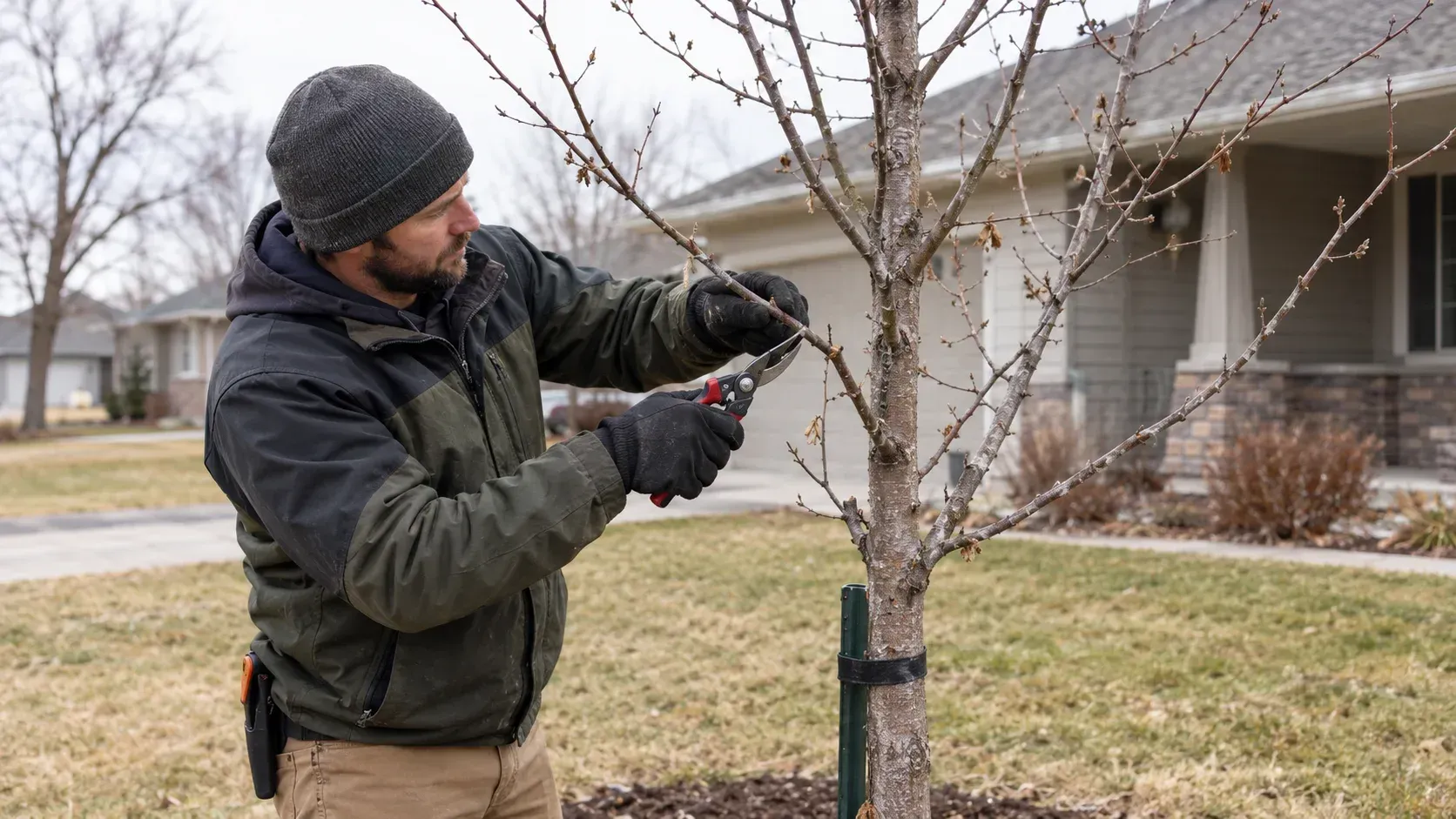
Table of Contents
- When to Prune a Young Tree in Denver, IA, and Why Waiting Wins
- What to Cut at Planting Time, and Nothing Else
- Why Late Winter Is the Window for Young Trees
- What Formative Pruning Actually Does
- The Year-by-Year Plan for Newly Planted Tree Care
- Mistakes We Get Called Out to Fix
- What Matters More Than Pruning in Year One
- When a Young Tree Needs Attention Before Late Winter
- Conclusion
Key Takeaways
- Skip it the first year, mostly. At planting, cut only what is broken, dead or torn. That is the whole job.
- Wait until late winter, ideally the second dormant season after planting, for the structural cuts that shape the tree.
- Formative pruning on a young tree prevents the expensive problems later: co-dominant leaders, included bark, branches that will rub for the next forty years.
- Light, frequent cuts on a young tree beat heavy corrective work on a mature one. Every time, and by a wide margin.
- Water and mulch matter more than pruning in year one. A tree with a poor root system cannot grow out of bad cuts.
Introduction
Prune a newly planted tree almost not at all in its first year. Take off what is broken, dead or torn during planting, and stop there. The real shaping work, the structural cuts that decide what the tree looks like in thirty years, should wait for late winter, and on most trees we would rather it wait until the second dormant season after planting, once the roots have had a full growing year to establish.
That answer disappoints people. Somebody buys a nice young maple, gets it in the ground, and wants to start shaping it that weekend. We understand the impulse. But a tree that just went in the ground is running on a root system that got cut back at the nursery, and it needs every leaf it has to rebuild that system.
Here is what to cut, when, and why the timing matters more on a young tree than on an old one.
When to Prune a Young Tree in Denver, IA, and Why Waiting Wins
Late winter, before the buds break. That holds for young trees in Denver and for every other town we work in around here.
The reason is simple enough. In late winter the tree is dormant, the structure is visible with the leaves off, and the cuts you make will start closing as soon as growth resumes in spring. Prune in fall and those wounds sit open through winter. Prune in the middle of spring flush and you are removing the leaves the tree just spent stored energy producing.
There is a second reason specific to young trees. A newly planted tree came out of the nursery with a fraction of the roots it grew there. Leaves are what rebuild the rest. Every branch you take off in year one is photosynthesis the tree does not get, at exactly the moment it needs it most.
So the order is: plant it, leave it alone, let it put on a season of growth, then shape it the following late winter. On a tree that went in this fall, that means shaping it in the late winter a year from now, not the one coming up.
What to Cut at Planting Time, and Nothing Else
There is a short list of cuts worth making when the tree goes in, and it is shorter than most people expect:
- Broken branches. Nursery stock takes a beating in transport. Anything snapped comes off.
- Dead wood, if there is any.
- Torn bark or a ragged stub, cleaned up to a proper cut so it can close.
- One of two branches that are already rubbing, if they are genuinely crossed and touching.
That is it. No thinning for shape. No heading back to "balance" the crown against the roots, which is old advice that turned out to be wrong. No removing the lower branches to make it look like a park tree, because those lower branches are feeding trunk growth right now.
We had a customer a few years back who topped a newly planted linden because a neighbour told him it would make it bushier. It did make it bushier, in the worst way: a cluster of weak shoots all competing from one point. We ended up removing most of that growth over two later visits to rebuild a single leader. Fixing it took longer than growing it would have.
Why Late Winter Is the Window for Young Trees
Iowa gives us a real dormant season, and that is an advantage. The window runs roughly from the back half of winter until buds start to swell, and within it you get four things at once:
- Visibility. With leaves off, you can see the actual branch architecture, which is exactly what formative pruning is about.
- Fast wound closure. Cuts made just before the growing season start sealing almost immediately.
- Low disease pressure. Many of the pathogens and insects that exploit fresh cuts are not active in cold weather. This matters most on oaks, where pruning during the active season carries real risk of oak wilt, so we keep oak work in the dormant window as a rule.
- Lower stress on the tree, since it is not in the middle of pushing new growth.
The general Iowa timing holds across tree types, and when and how to prune different tree species gets into the by-species detail on mature trees, which is a different job from the one this article covers.
What Formative Pruning Actually Does
This is the part worth understanding, because it explains why a few small cuts on a young tree are worth more than a big job later.
Formative pruning, sometimes called structural pruning, is about deciding the tree's permanent architecture while the branches are still thumb-sized. You are looking for and correcting:
- Co-dominant leaders. Two stems of similar size competing to be the main trunk. Pick one. The other becomes a failure point in twenty years when it splits out in a wind or ice event.
- Included bark. Where a branch and trunk grow so tightly together that bark gets pinched between them instead of wood knitting. Those unions are weak, and they are the ones that tear out.
- Narrow branch angles. Tight V-shaped unions are weaker than wider ones.
- Branches that will rub, caught while removing one is a small cut.
- Poor spacing, where several branches emerge from nearly the same point on the trunk.
- Crossing or inward-growing limbs.
Here is the payoff. Removing a branch the diameter of your finger leaves a wound the tree closes in a season. Removing that same branch in fifteen years means a cut the size of your palm, a wound that may never fully close, and a hole in the crown. Same decision, wildly different cost.
Most of the mature-tree failures we get called to after a storm trace back to a structural problem that was visible and fixable when the tree was young. Nobody looked.
The Year-by-Year Plan for Newly Planted Tree Care
A rough schedule that works for most species we plant around here:
At planting. Broken, dead and torn wood only. Stake only if the tree genuinely will not stand, and plan to remove the stakes within a year, because a tree that sways builds a stronger trunk than one held rigid.
Year one, growing season. Hands off the pruners. Water is the job. Mulch a few inches deep in a ring out from the trunk, never piled against the bark, because mulch against the trunk holds moisture on it and invites rot and rodents.
First dormant season, late winter. A look, not a project. Remove anything that died back or broke over winter. If there is an obvious competing leader on a fast-growing species, you can address it now. Otherwise wait.
Second dormant season. This is the real first structural pruning. The tree has two growing seasons of root establishment behind it and there is enough branch structure to make real decisions about. Pick the leader, correct the worst unions, space the scaffold branches.
Years three through roughly eight, each late winter. Small annual passes. This is where the tree gets made. Ten minutes a year here replaces a major job later.
After that. Move to a longer maintenance interval, and you are into normal mature-tree pruning.
Lower branches deserve a note. The instinct is to strip them off early to get clearance. Resist it. They are feeding trunk taper, which is what makes a young trunk strong. Raise the crown gradually over several years instead of all at once.
Mistakes We Get Called Out to Fix
We see the same handful, in rough order of how often:
- Topping. Cutting the leader back to make a tree bushier or shorter. It produces weak, densely clustered shoots and permanently compromises the structure. There is no version of this that works.
- Pruning too much, too early. A newly planted tree cannot spare the leaves.
- Flush cuts. Cutting tight to the trunk removes the branch collar, which is the tissue that actually closes the wound. Cut just outside it.
- Leaving long stubs. The opposite error. Stubs do not close and they die back into the trunk.
- Fall pruning. It feels like yard cleanup season. The wounds then sit open all winter.
- Painting or sealing cuts. Wound dressings do not help and can trap moisture. Leave cuts open.
- Stripping all the lower branches in year one.
- Mulch volcanoes. Mulch mounded up against the trunk. Extremely common, genuinely damaging.
If you have already done one of these, most of it is recoverable on a young tree. Topping is the hardest to undo, and even that can often be rebuilt over a few seasons if the tree is still small.
What Matters More Than Pruning in Year One
This is the honest part, and it might cost us a pruning call.
If you only get one thing right on a newly planted tree, make it water. Consistent, deep watering through the first two growing seasons does more for that tree than any pruning decision. A tree with an established root system will tolerate mediocre pruning. A tree with a failing root system cannot be pruned into health.
After water: mulch, correctly, in a wide ring and off the trunk. Then planting depth, which is the one nobody can fix later. A tree planted too deep, with the root flare buried, will struggle for its entire life, and no amount of pruning touches that problem.
So if you planted something this year and you are wondering whether to prune it, the better question is usually whether it is getting enough water and whether the flare is sitting at grade.
When a Young Tree Needs Attention Before Late Winter
A few situations override the wait-for-dormancy rule, because safety and damage beat timing:
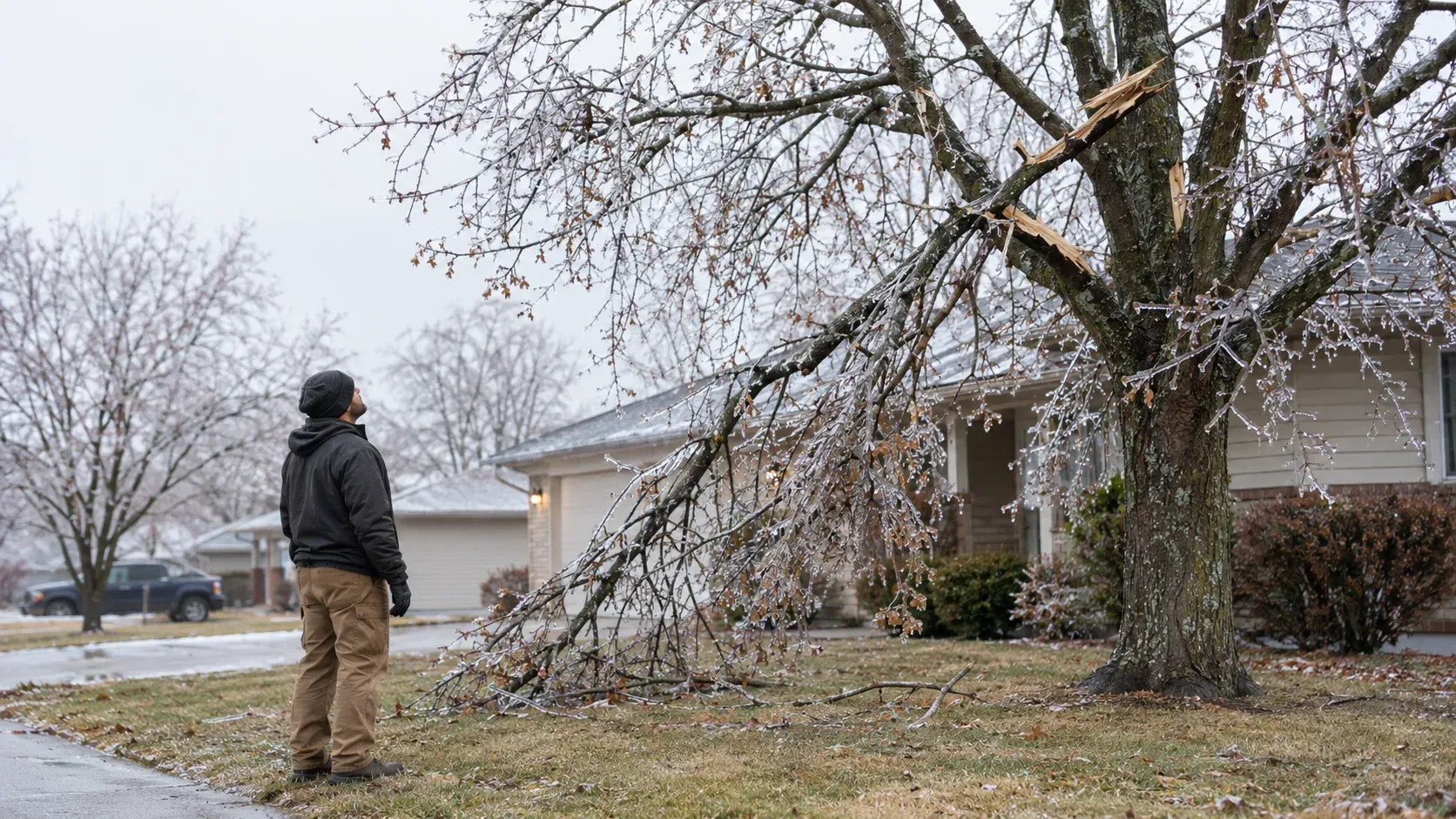
- A branch broke in a storm or a wind event. Clean it up now rather than leaving a torn stub.
- Visible disease or dieback spreading through the crown.
- A branch is a hazard, over a walkway, a driveway, a door.
- Storm damage to the leader or trunk, which needs an actual assessment rather than a pruner.
- Rubbing that is already wounding bark, where waiting means a bigger wound.
Damage repair is not the same as shaping. Deal with the damage whenever it happens, then do the structural work in the dormant window as planned.
Conclusion
On a newly planted tree, restraint is the technique. Cut the broken and dead wood at planting, spend year one watering, then start the structural work in late winter once the roots are established, and keep doing small annual passes through the tree's first several years.
The trees that give people trouble at thirty years old are almost never the ones that got pruned too little when they were young. They are the ones nobody shaped at all, or the ones that got topped by somebody trying to help.
Get a Free Pruning Assessment
If you have a young tree in the ground and you are not sure whether it needs anything, we will come look at it and tell you. Sometimes the answer is that it is fine and we will see you in a year, which is a perfectly good outcome for a phone call.
Fowlkes Tree and Stump Removal has been working on trees around here since 2013, we are fully licensed and insured, and we provide free quotes and consultations. The pruning side of what we do covers light pruning to shape a young tree as well as heavier corrective work on mature ones, and the young-tree visits tend to be short and cheap.
We are in Denver regularly, along with Cedar Falls, Waterloo, Independence, Evansdale, La Porte City, Hudson and Center Point. If you are in town, our
tree services in Denver, IA covers pruning, removal and stump grinding. Call
(319) 327-1199.
Frequently Asked Questions
Should I prune a tree right after planting it?
Only the damage. Remove broken, dead or torn branches, and clean up any ragged stubs so they can close. Skip all shaping and thinning, because a newly planted tree needs its leaves to rebuild the roots it lost at the nursery.
How long should I wait before structural pruning a young tree?
Usually until the second dormant season after planting. That gives the tree a full growing year to establish roots, and by then there is enough branch structure to make real decisions about the leader and scaffold branches.
Can I prune a young tree in the fall in Iowa?
We would not. Fall feels like cleanup season, but those wounds sit open through winter instead of closing. Late winter, before buds break, gives you visible structure and fast wound closure once growth resumes.
Is it bad to remove the lower branches of a young tree?
Removing them all at once is. Lower branches feed trunk taper, which is what makes a young trunk strong. Raise the crown gradually across several years instead of stripping it for clearance in the first season.
What happens if a young tree was topped?
You get a cluster of weak shoots competing from one point rather than a single leader. On a small tree it can often be rebuilt over a few seasons by selecting one shoot and removing the competition, but it takes patience.
Related Posts