Does a Shelf Fungus or Mushroom Growing on an Iowa Tree Trunk Mean the Tree Is Rotting Inside and Needs to Come Down?
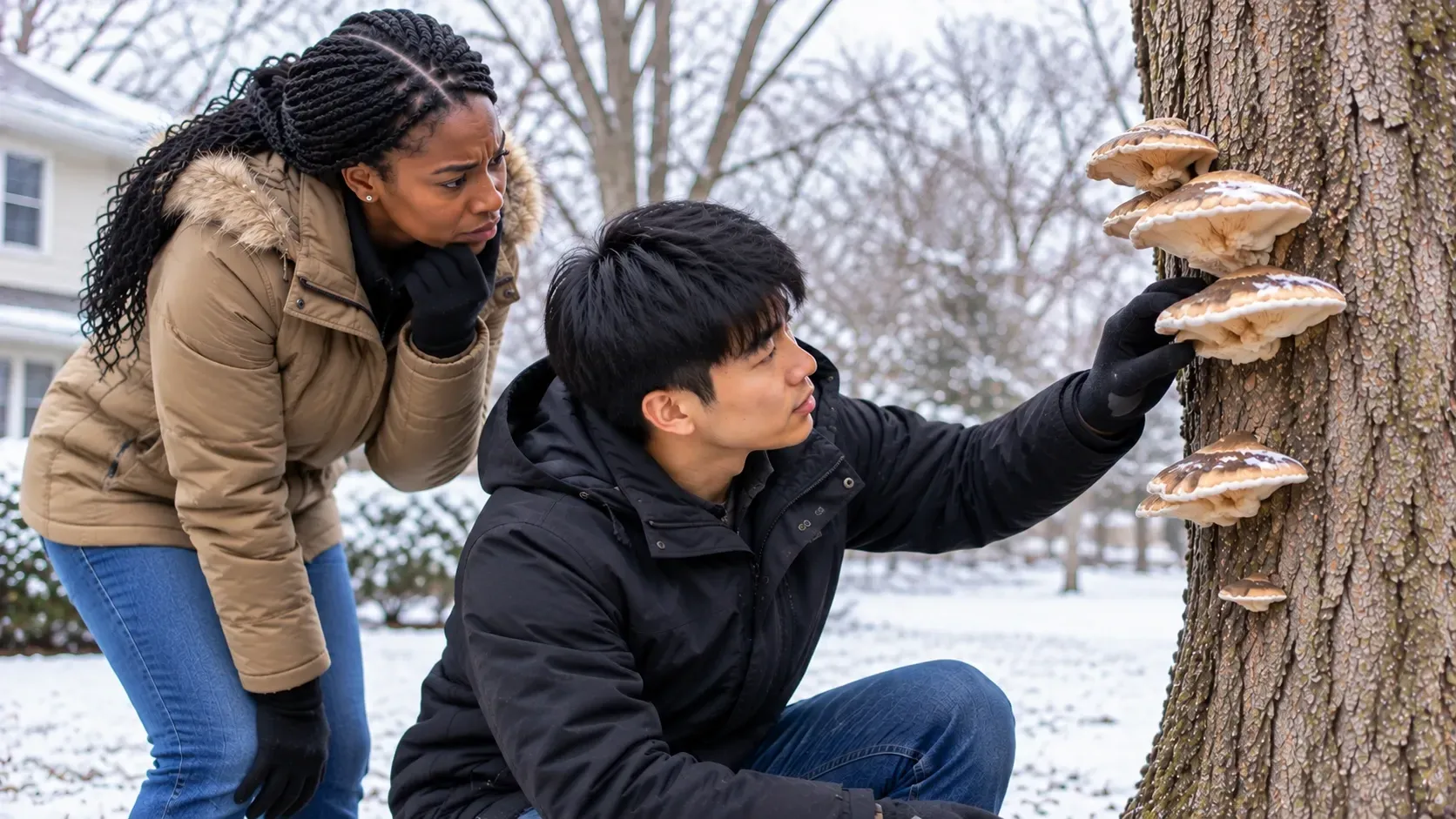
Table of Contents
- Introduction
- What a Shelf Fungus Actually Tells You
- Where the Fungus Grows Matters More Than Which One It Is
- Not Every Mushroom Near a Tree Is Bad News
- Tree Trunk Fungus Does Not Automatically Mean Removal
- The Ones We Take Seriously
- When to Get a Tree With Fungus Looked At
- Conclusion
- Found Something Growing on a Tree Near Your House?
- Frequently Asked Questions
Key Takeaways
- The mushroom is the fruiting body. The fungus was inside the wood long before you saw it.
- Position tells you more than species. At the base is a different problem from up on a dead stub.
- Mushrooms in the grass near a tree are often helping it, not harming it.
- Decay does not automatically mean removal. How much sound wood is left decides that.
- Nobody can assess decay from a photograph, including us.
Introduction
A shelf, bracket or mushroom growing out of a trunk or at the base usually does mean a wood-decay fungus is already working inside the tree, but it does not automatically mean the tree comes down, which is why the warning signs worth acting on depend on where the fungus is growing and how much of the trunk it has reached.
Winter is when people notice these. The leaves are off, you can see the trunk properly, and suddenly there is a hard brown shelf halfway up a maple that has been there longer than you think.
What a Shelf Fungus Actually Tells You
That the fungus is established, not that it is arriving.
The shelf you are looking at is a fruiting body. It is the reproductive structure, the part the fungus puts out to release spores. The organism itself is a network of fine threads already living inside the wood, and it has usually been in there for a while before it has enough resources to fruit.
The comparison we use: seeing an apple on a branch does not mean an apple tree just appeared. The tree was there first. A conk works the same way.
So the useful question about tree trunk fungus is never whether it got in. It did. The question is what it has been eating, and how much is gone.
Where the Fungus Grows Matters More Than Which One It Is
This is the part most articles skip, and it is the thing that actually changes the answer.
| Where it is fruiting | What it usually points to |
|---|---|
| Root flare, buttress roots, soil at the base | The most serious. Root and butt decay |
| Low on the trunk | Decay in the load-bearing column |
| Higher up, at an old wound or pruning cut | Often more localized, still worth checking |
| On a dead branch or branch stub | Frequently just dead wood being recycled |
| On a cut stump | Decomposition doing its job, not a threat |
Tree trunk fungus at the base is the one that worries us most, and the reason is mechanical. A tree with a decayed trunk higher up tends to fail by breaking, which is bad. A tree with decayed roots and butt tends to fail by going over whole, which is worse, and it gives almost no warning because the damage is underground where nobody can see it.
That is also why we are not going to turn this into a species identification guide. Knowing you have an artist's conk rather than a dryad's saddle is interesting. Knowing it is fruiting from the root flare of a tree that leans over your driveway is actionable.
Not Every Mushroom Near a Tree Is Bad News
Worth saying clearly, because people pull perfectly healthy trees over this.
Fungi around a tree fall into roughly three groups:
- Decay fungi, which digest the wood of a living tree. These are the ones that matter, and they fruit from the tree itself.
- Saprophytes, which break down dead organic material. Old buried roots, a long-gone stump, wood chips in the mulch ring. They are recycling, not attacking.
- Mycorrhizal fungi, which live in partnership with tree roots and genuinely help the tree take up water and nutrients. Their mushrooms come up in the soil, often in a rough ring under the canopy.
That third group surprises people. A flush of mushrooms in the lawn under an oak after a wet week is often a sign the soil is working the way it should.
The rough test is attachment. If it is fruiting out of the tree, ask somebody. If it is coming up out of the grass nearby and not attached to anything, it is usually fine. Not always, because something feeding on a dead root is worth noticing, but usually.
Tree Trunk Fungus Does Not Automatically Mean Removal
We will say that plainly even though we are the people who take trees down.
Trees are good at walling decay off. A tree can carry a decayed section for a very long time while laying down sound wood around it, and plenty of trees with visible conks stand safely for years. What decides the outcome is how much sound wood remains, where the weak part sits, how the tree is loaded, and what is underneath it.
Which means the honest set of outcomes is wider than remove or do not remove:
- Monitor it, with a look again in a year
- Reduce the load, by taking weight out of the canopy over the vulnerable section
- Change what is underneath, moving where people park or where the kids play
- Remove it, when the sound wood left will not do the job
A tree with a conk at the back of an acreage, with nothing underneath it but grass, is habitat. Woodpeckers want it. We will tell you to leave it, and that is not us being generous, it is just the right answer.
The Ones We Take Seriously
Short list. Any of these and we would rather look sooner than later.
- Fruiting at the root flare or on the buttress roots, particularly on a tree near a structure
- A large bracket low on the trunk of anything standing over a house, driveway or parking area
- Several brackets up the stem, which suggests the decay column runs
- Fungus plus another symptom: a new lean, lifted or cracked soil at the base, a thinning canopy, deadwood in the upper crown
- Fungus on a tree whose roots were cut in recent construction, trenching or driveway work
- Wood at the base you can push a screwdriver into without much effort
That last one is the most useful thing you can do yourself. Not a diagnosis, but if the wood gives way easily where it should be solid, you have learned something real. Trees already carrying storm damage risk or old ice damage deserve a closer look, since the wounds those leave are how decay gets in.
When to Get a Tree With Fungus Looked At
Sooner, if the tree can reach anything you care about. Winter is the easiest time to see what you are dealing with.
Two things we want to be straight about.
We will not diagnose a tree from a photograph. Not for you, not for anybody. Assessing decay means somebody standing at the base, sounding the trunk, looking at the root flare and the canopy together, and considering what the tree is carrying. A picture of a bracket tells us a bracket exists.
This is an article about tree health, not about foraging. A lot of people searching shelf fungi are looking for something to eat. Do not eat anything growing on a tree on the strength of a web page, ours included. We are a tree service, we are not going to identify species for you, and misidentification in that direction has consequences we are not qualified to speak to.
For Waterloo yards and Independence homeowners alike, the trees that worry us are the big ones near the house. If that is what you are looking at, have somebody put hands on it. If the tree does come out, our comparison of grinding versus removing the stump covers what happens next.
Conclusion
Go look at the base of your big trees this winter while you can see them properly. You are looking for anything hard and shelf-like growing out of the trunk or the root flare, and for wood at the bottom that gives when it should not. Find one of those on a tree standing over something that matters and make the call. Find mushrooms in the grass under the canopy and you have probably just found evidence that the soil is doing its job.
Found Something Growing on a Tree Near Your House?
Send us the address rather than the photo and we will come put hands on the tree. We will tell you honestly whether it needs to come down, needs weight taken out of it, or just needs looking at again next winter. Fowlkes is family owned, founded in 2013, fully licensed and insured, with over 14 years of experience and certified arborists on the crew. The first visit to look at your tree is free, and we provide free quotes and consultations. We serve Independence, Cedar Falls, Waterloo, Evansdale, La Porte City, Hudson, Denver, Center Point and Hiawatha, with 24/7 emergency service. See what goes into a tree removal, or call (319) 327-1199 and talk to Dustin.
Frequently Asked Questions
Does a mushroom on a tree trunk mean the tree is dying?
It means decay is established inside, since the mushroom is a fruiting body of a fungus already living in the wood. It does not mean the tree is dying or must come down. How much sound wood remains, and what stands underneath, decide that.
Is a shelf fungus on a tree dangerous?
The fungus itself is not the danger. The decay behind it can be, especially when it is fruiting from the root flare or low on the trunk of a tree near a house or driveway, because that is where structural failure starts.
Should I remove a tree with fungus growing on it?
Not automatically. Trees wall off decay and many stand safely for years with visible conks. Monitoring, reducing canopy weight, or changing what sits underneath are all real options. Have it assessed in person before deciding.
Can I just cut the shelf fungus off?
It will not help. The fruiting body is the visible part of a fungus already growing through the wood inside, so removing the shelf changes nothing about the decay. It also removes the evidence that told you to look.
Are mushrooms growing in the grass under my tree a problem?
Usually not. Many are mycorrhizal fungi that partner with tree roots and help the tree, or saprophytes recycling dead material in the soil. The ones worth asking about are those fruiting from the tree itself rather than from the ground nearby.
Related Posts