Winter Tree Removal in Iowa: Does Frozen Ground Aid Lawns?
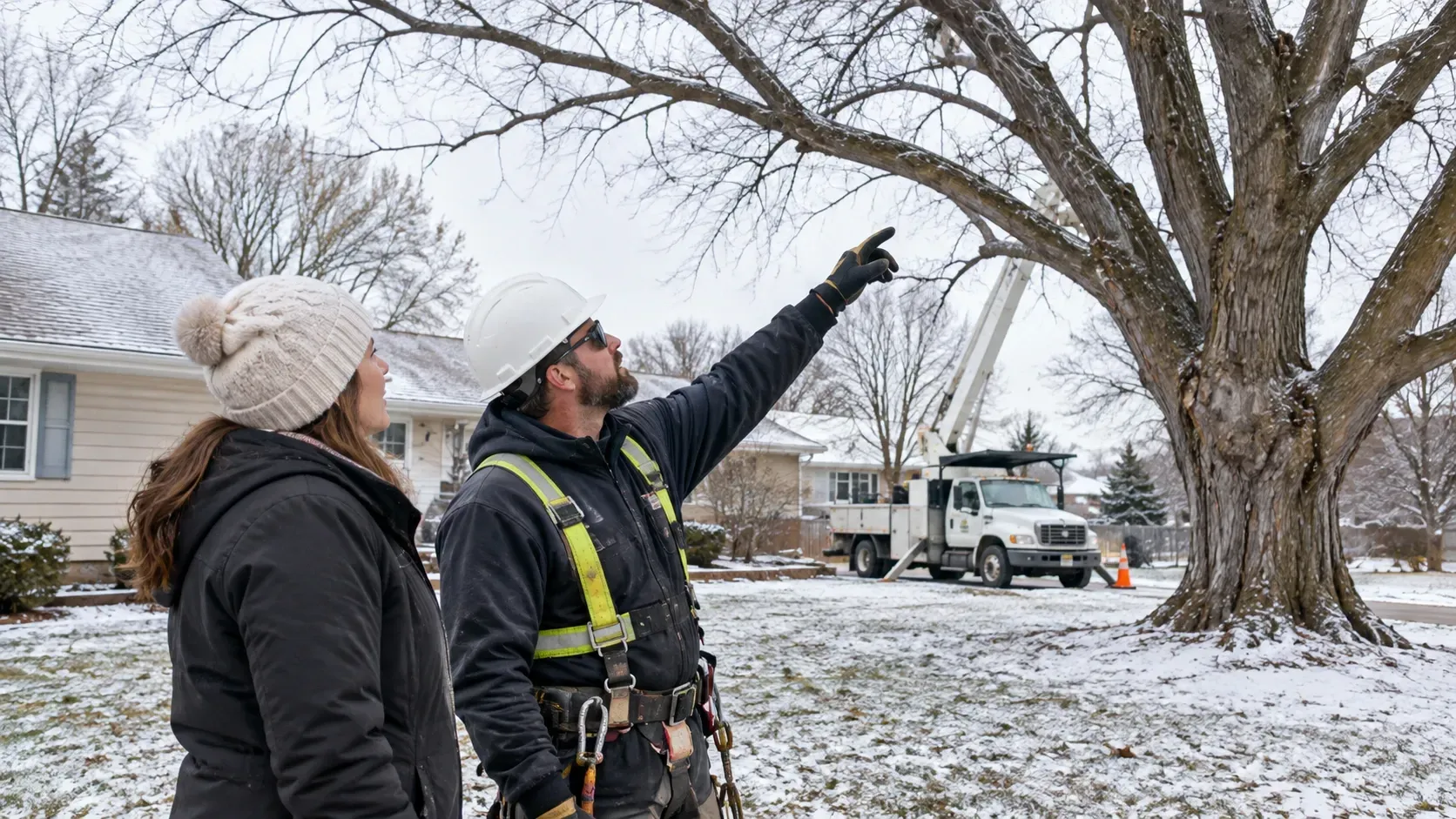
Table of Contents
- Introduction
- Why Frozen Ground Helps a Winter Tree Removal
- Leafless Trees Are Easier to Read and Rig
- When the Frozen Ground Is Not Actually Frozen
- What Can Delay Winter Tree Removal
- What We Do to Protect the Lawn in Any Season
- Booking Ahead of the Spring Rush
- Conclusion
- Thinking About a Big Removal This Winter?
- Frequently Asked Questions
Key Takeaways
- Frozen ground spreads equipment weight instead of letting it sink. That is the real lawn benefit.
- It also protects the root zones of the trees you are keeping, which nobody thinks about.
- Bare branches are easier to read, lighter to rig and leave less to haul.
- A January thaw is worse than summer, because nothing is growing to recover.
- The right window depends on conditions. We will tell you when to wait.
Introduction
Winter can be a genuinely good time for a large planned removal, because frozen ground carries heavy equipment without rutting the lawn and a leafless canopy is easier to read and rig, but deep snow, ice and wind all push work back, so the best window depends on conditions rather than on the month.
We have been doing this around northeast Iowa since 2013. Some of the cleanest work we do all year happens in January. Some Januaries barely give us a usable week.
Why Frozen Ground Helps a Winter Tree Removal
Because weight behaves differently on ground that has set up hard.
In soft soil, a loaded truck or a lift concentrates its weight into a narrow footprint and sinks. That is what makes ruts. Ruts in a lawn are a repair job on top of the removal.
On frozen ground the load spreads across the surface instead of pressing into it. The same machine that would leave tracks in May leaves very little in January.
The benefit most homeowners never consider is underneath:
- Less soil compaction. Compacted soil squeezes out the air and water pathways roots depend on, and it does not recover quickly.
- Protection for the trees you are keeping. If the tree coming out is near others, driving over their root zones is one of the quieter ways to damage a tree you wanted to save.
- Cleaner access across turf. Less mud dragged across the yard and onto the drive.
That compaction point matters more than the ruts do. Ruts are visible and fixable. Compaction is invisible and it lingers.
Leafless Trees Are Easier to Read and Rig
A bare tree tells you more and fights you less.
With the leaves off, the structure is visible: where the limbs attach, which unions look suspect, where the deadwood is, how the weight is actually distributed. That matters most on the big removals, because the plan is built around what we can see.
It is also physically easier work:
- Less weight. A full canopy of leaves is a real load on every piece being lowered.
- Less sail area. Wind catches a leafed canopy and makes a hanging section swing.
- Less to clean up. The leaf volume is simply not there.
- Better sight lines between the climber or operator and the ground crew.
On a tight site, this is exactly when crane-assisted removal works best. The operator can see what they are picking.
Dormancy helps too. A tree removed while everything around it is dormant disturbs its neighbours less than the same job in June. For species where seasonal timing affects disease spread, oaks in particular, the dormant window is the conventional choice, and Iowa State University Extension is the place to check what applies to your species rather than taking a date from us.
When the Frozen Ground Is Not Actually Frozen
Here is the part the frozen-ground argument usually leaves out.
Iowa winters are not uniformly frozen. We get thaws, and a thaw in February turns the top several inches to mud sitting over ground that is still hard underneath. Water cannot drain down through the frozen layer, so it sits in the soft layer on top.
That is worse than summer. Mud in July gets driven on, and then grass grows and the lawn knits back together over a few weeks. Mud in February gets driven on and then sits there until April, because nothing is growing to repair it. You look at the damage for two months.
So frozen ground is a condition, not a season. When we quote a winter removal we are watching the forecast, and if the ground is going soft we would rather move the date than hand you a rutted yard and an apology.
What Can Delay Winter Tree Removal
Honest list, because a December booking is not a December guarantee.
- Ice on the stem and limbs. A climber cannot work a glazed tree safely and will not try. This one is non-negotiable.
- High wind. Rigging a heavy section in wind is how people get hurt.
- Deep snow. It hides stumps, landscape edging, septic lids, well heads and anything else that can damage equipment or get damaged by it.
- Short daylight. Large removals need the hours, and December gives us fewer of them.
- A thaw, per the section above.
None of that makes winter a bad choice. It makes a winter tree removal a job where flexibility on the date is worth more than a fixed appointment. The smoothest winter jobs we do are for the people who said call us when conditions are right.
What We Do to Protect the Lawn in Any Season
Frozen ground is a help, not a plan. The plan is the same year round.
We walk the access route before anything drives on it and work out where equipment goes. We use the shortest and firmest path from the street. Where the ground is soft or the route crosses turf that matters, mats or plywood spread the load. And the stump work is planned at the same time, because dragging the grinder across the yard a week later undoes the care taken the first time.
Two things on your side that help more than you would think: tell us about anything buried, and tell us what matters to you. Our guide on how to prepare your yard covers the rest, and if the stump is staying behind for now, the argument against that is in our look at leaving the stump.
Booking Ahead of the Spring Rush
The practical reason to sort a non-urgent removal in winter has nothing to do with the ground.
It is that the first real spring storm fills every tree company's schedule in a day. Emergency work jumps the queue, correctly. The planned removal that could have happened in February then waits behind storm cleanup into April and May.
If the tree is not an emergency and it is coming out this year anyway, getting it assessed and scheduled during winter puts you ahead of that. The first visit to look at your tree is free, so finding out where you stand costs nothing.
One thing we are not going to tell you is that winter is cheaper. Pricing comes down to the tree, the access and the complexity, not the month on the calendar. If you want to know what yours costs, ask and we will look at it. Around Cedar Falls and the rest of our area, the honest answer is that the job is priced the same way all year.
Conclusion
Book the assessment in winter and stay flexible on the day. Frozen ground really does protect a lawn, bare branches really are easier to work, and both of those are worth having. Just do not treat the calendar as the condition. January can hand you perfect ground or four inches of mud over a frost layer, and the difference between those two is the difference between a yard you cannot tell we worked in and one you are reseeding in April.
Thinking About a Big Removal This Winter?
Call us and we will come look at the tree, the access and the ground, and tell you honestly whether to go now or wait for better conditions. Fowlkes is family owned, founded in 2013, fully licensed and insured, with over 14 years of experience and crane capability for trees in difficult positions. The first visit to look at your tree is free and we provide free quotes and consultations. We serve Independence, Cedar Falls, Waterloo, Evansdale, La Porte City, Hudson, Denver, Center Point and Hiawatha, with 24/7 emergency service when something comes down on its own. Call (319) 327-1199 or get a quote.
Frequently Asked Questions
Is winter a good time to remove a tree?
Often yes. Frozen ground carries equipment without rutting the lawn, bare branches are easier to read and rig, and dormant neighbouring trees are disturbed less. The catch is that ice, wind, deep snow and thaws all push work back, so flexibility on the date matters.
Does frozen ground really protect your lawn?
Yes, when it is genuinely frozen. Hard ground spreads equipment weight across the surface instead of letting it sink, which prevents both ruts and soil compaction. During a thaw the opposite is true, and winter mud takes longer to recover than summer mud.
Is tree removal cheaper in winter?
Not here. Our pricing follows the tree, the access and the complexity of the job rather than the season. Ask for a quote and we will tell you what yours costs regardless of the month.
Can you remove a tree when there is snow on the ground?
Usually, within limits. Light snow is not an obstacle. Deep snow hides stumps, edging, septic lids and well heads, which is a risk to both the equipment and the property, so heavy accumulation can mean waiting.
When should I book a non-emergency removal?
Winter, if the tree is coming out this year. The first spring storm fills every schedule in the area, and planned work ends up queued behind emergency cleanup for weeks.
Related Posts